
RDF, Labeled Property Graphs, and Retrieval
 Isaac Kargar7 min read
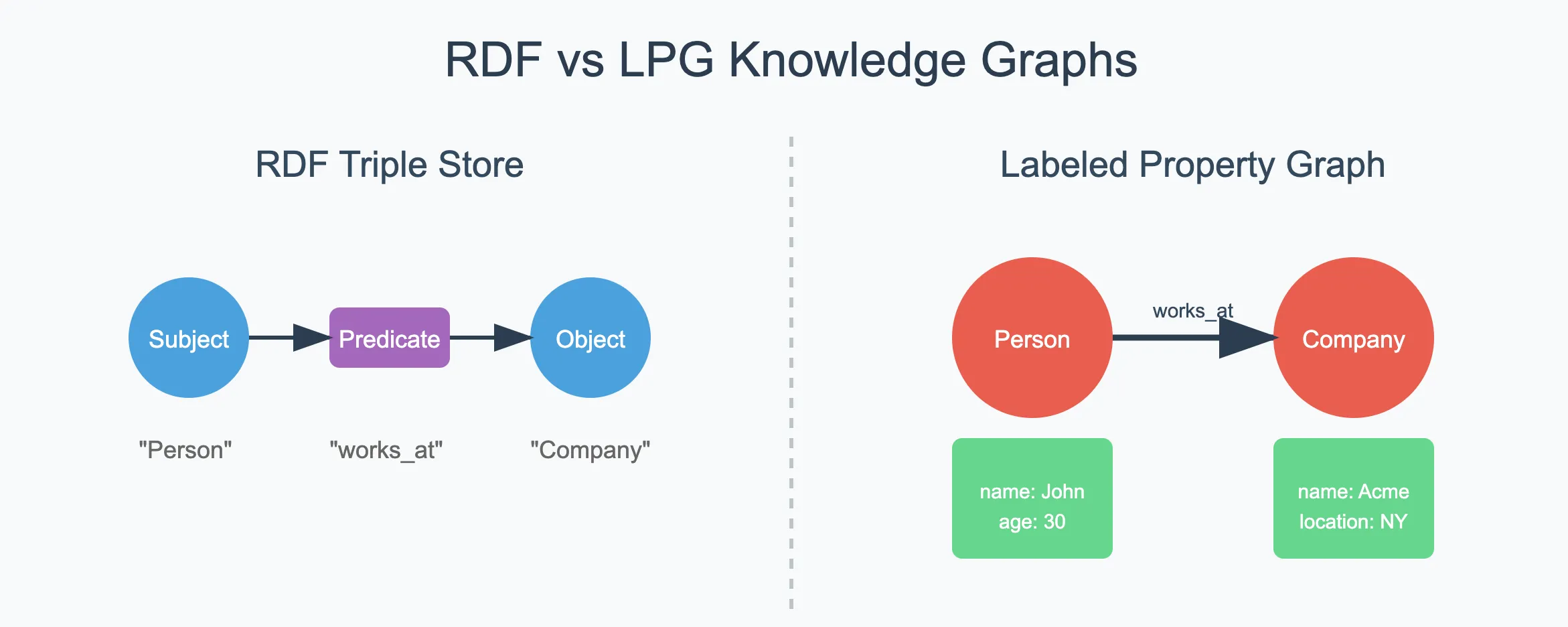
Knowledge graphs organize facts around entities and their relationships. RDF and labeled property graphs are two common data models for doing that. They can both represent a statement such as “John likes Pizza,” but they differ in how the statement is encoded, queried, and extended with semantics.
This article introduces RDF, OWL, and SPARQL, compares them with labeled property graphs, and then shows how either model can participate in retrieval-augmented generation (RAG). The choice depends on the data model, query style, interoperability needs, and reasoning requirements.
Two graph models
RDF represents a statement as a triple: subject, predicate, and object. The subject and predicate are resources, and the object can be another resource or a literal value. RDF has W3C standards for its data model and query language. The RDF 1.1 Concepts specification describes the model, and SPARQL 1.1 Query describes a standard query language.
A labeled property graph represents nodes and relationships. Nodes and relationships may carry labels and key-value properties. Products commonly expose languages such as Cypher, Gremlin, or GSQL. The Neo4j graph model guide is one concrete description of the labeled property graph approach.
Both models can store structured facts and support substantial workloads. RDF commonly emphasizes globally identified statements, shared vocabularies, and formal semantics. A labeled property graph commonly emphasizes direct traversal and properties attached to the nodes and relationships being traversed. These are common arrangements, not hard limits on every implementation.
RDF
Triples and vocabularies
RDF uses a directed graph of statements. In this small Turtle example, ex:John is a person, ex:John likes ex:Pizza, and ex:Pizza is food:
@prefix ex: <http://example.org/> .
@prefix rdf: <http://www.w3.org/1999/02/22-rdf-syntax-ns#> .

ex:John  rdf:type    ex:Person ;
         ex:likes    ex:Pizza .
ex:Pizza rdf:type    ex:Food .
The three parts of ex:John ex:likes ex:Pizza are:
- the subject,
ex:John; - the predicate,
ex:likes; and - the object,
ex:Pizza.
RDF identifiers make it possible for separate datasets to refer to the same resource when they use compatible identifiers and vocabularies. RDF itself describes the graph data model. Ontologies and validation standards add further meaning or constraints.
OWL and entailment
OWL, the Web Ontology Language, extends RDF with classes, properties, restrictions, and logical axioms. An OWL reasoner can use those axioms to derive statements that were not written explicitly.
Here is a compact Turtle axiom. It defines FoodLover as the class of people who like at least one food:
@prefix ex: <http://example.org/> .
@prefix owl: <http://www.w3.org/2002/07/owl#> .

ex:Person    a owl:Class .
ex:Food      a owl:Class .
ex:FoodLover a owl:Class .
ex:likes     a owl:ObjectProperty .

[
  a owl:Class ;
  owl:intersectionOf (
    ex:Person
    [
      a owl:Restriction ;
      owl:onProperty ex:likes ;
      owl:someValuesFrom ex:Food
    ]
  ) ;
  owl:equivalentClass ex:FoodLover
] .
The anonymous class is the intersection of Person and “likes some Food.” Because the example data says that John is a person, John likes Pizza, and Pizza is food, a reasoner can derive:
ex:John rdf:type ex:FoodLover .This derived triple is an OWL entailment under the ontology and the reasoner’s supported profile. Soundness and completeness are relative to that logic profile and implementation. They are not blanket guarantees for every OWL feature, custom rule, data-quality problem, or deployment.
RDF data and ontology definitions can be stored together or in separate files. A common vocabulary is sometimes called the TBox, while instance assertions are called the ABox. Those terms describe the roles of the data; they do not require a particular file layout.
An LLM can summarize RDF facts or answer a natural-language question using retrieved triples. Its generated text is not itself a formal proof that the ontology entails the answer. If an application needs an entailment check, it should use the graph query and the configured reasoner for that check.
Labeled property graphs
The same facts can be represented with nodes, labels, and a relationship. This example uses Cypher syntax:
CREATE (john:Person {name: "John"})
CREATE (pizza:Food {name: "Pizza"})
CREATE (john)-[:LIKES]->(pizza)
The Person and Food labels classify the nodes, the LIKES relationship connects them, and name is a node property. A traversal can find people who like food directly:
MATCH (person:Person)-[:LIKES]->(food:Food)
RETURN person.name, food.name
There is no single standardized OWL-style entailment mechanism built into the labeled property graph model. An application can materialize a label or property:
MATCH (person:Person)-[:LIKES]->(food:Food)
SET person:FoodLover
It can also keep the condition as a query, use a procedure, or run application logic. The result can be useful, but its semantics and maintenance rules come from the chosen application and product. Capabilities such as triggers, graph algorithms, constraints, and vector indexes are product-specific features rather than properties of every labeled property graph.
RDF and labeled property graphs in RAG
RAG retrieves context before asking an LLM to produce an answer. A graph can contribute explicit entities, relationships, types, and provenance to that context. Structured retrieval can make relevant paths easier to inspect and can support filters such as “only products offered by this restaurant.” It helps an application provide evidence; it does not guarantee that the final generated answer is correct or trustworthy.
Comparing the models
| Consideration | RDF and OWL | Labeled property graph |
|---|---|---|
| Basic representation | Subject-predicate-object triples with identified resources | Nodes and relationships with labels and properties |
| Query style | SPARQL graph patterns and standard RDF vocabularies | Traversal and pattern queries such as Cypher or Gremlin |
| Formal semantics | OWL can define axioms for a supported reasoning profile | Application or product logic supplies additional rules |
| Interoperability | W3C data and ontology standards can support dataset alignment | Interoperability depends on the product model, export format, and mappings |
| RAG contribution | Typed facts, ontology terms, entailments, and queryable provenance | Direct traversals, relationship properties, and application-specific filters |
| Main tradeoff | Ontology and reasoning work can add modeling and operational complexity | A direct model can be easier to start with, while semantics must be designed separately |
RDF with OWL is a strong fit when formal vocabulary alignment or reasoning under a defined logic profile is central. A labeled property graph is a strong fit when direct traversals, relationship properties, and an application’s graph operations are central. A benchmark or prototype should measure the selected system with its actual workload rather than assuming one model wins every task.
Combining graph and vector retrieval
Embeddings provide a way to search text by semantic similarity. A graph provides explicit relationships and metadata. An application can combine them in several steps:
- Store entities, documents, and relationships in the graph or keep graph identifiers beside the documents.
- Choose the text fields that should be embedded, such as a description or a document section.
- Generate an embedding for each selected text field and store it in a vector index. The index can be part of a graph product or a separate service that keeps the graph identifier as metadata.
- Embed the user’s query with a compatible model and retrieve the nearest text records.
- Use graph edges, types, access rules, and metadata to expand, filter, or re-rank those candidates.
- Pass the selected text and structured facts to the LLM, with source identifiers that let the application display the evidence.
For example, a vector search for “Italian cheese dishes” may retrieve several pizza descriptions. A graph traversal can then filter those candidates by an explicit HAS_INGREDIENT edge or by a dietary restriction. A second traversal can identify which restaurant offers the dish. The vector search supplies a semantic starting point; the graph applies relationships and constraints that are difficult to express as nearest-neighbor similarity alone.
The same pipeline can use RDF queries and OWL entailments, or labeled property graph traversals and application rules. If reasoning is required, the application should record which reasoner, ontology profile, or custom rule produced each derived fact. If provenance matters, it should carry source identifiers through retrieval and generation.
Choosing a model
Start with the questions the system must answer and the evidence it must expose. RDF is a natural candidate when shared identifiers, W3C vocabularies, and formal reasoning are requirements. A labeled property graph is a natural candidate when the main workload is direct traversal over rich node and relationship properties.
Both models can be paired with vector retrieval. The useful design work is deciding what the graph should constrain, what text the vector index should retrieve, how source records are carried into the prompt, and how generated answers are checked. Those decisions determine whether a RAG application can show relevant evidence and apply the domain’s rules.
Work with Nazmi
Build your AI system with Nazmi.
Tell us what you are building, what exists today, and where your team needs help.
Start a conversation or book a 20-minute call →