
Agents Are Not Enough
 Isaac Kargar2 min read
Agents Are Not Enough, by Chirag Shah and Ryen W. White, argues that making one autonomous program more capable does not solve every problem involved in deploying agents for people. The paper reviews several generations of agent research and proposes an ecosystem around the agent itself.
The proposal has three parts:
-
Private and secure agents protect a person’s information while still allowing an agent to complete useful work.
-
User representations, called Sims, carry a person’s preferences and privacy choices. A Sim can represent the user when several services need to coordinate.
-
Agent communication lets an agent that knows the user’s preferences communicate with another agent that provides a specialised service.
A concrete interaction
Imagine that a user’s Sim stores a preference for morning flights and a limit on the fare. The user’s Assistant can ask the Sim for those constraints, then ask a travel agent to search for flights. The travel agent can return candidates to the Assistant, which presents the result to the user. In this design the Sim represents the user, the Assistant coordinates the interaction, and the specialised agent performs the domain task.
The authors describe the surrounding ecosystem with three roles:
- Agents perform specialised tasks.
- Sims represent users, including their preferences and privacy settings.
- Assistants coordinate interactions between a user, the user’s Sim, and task-specific agents.
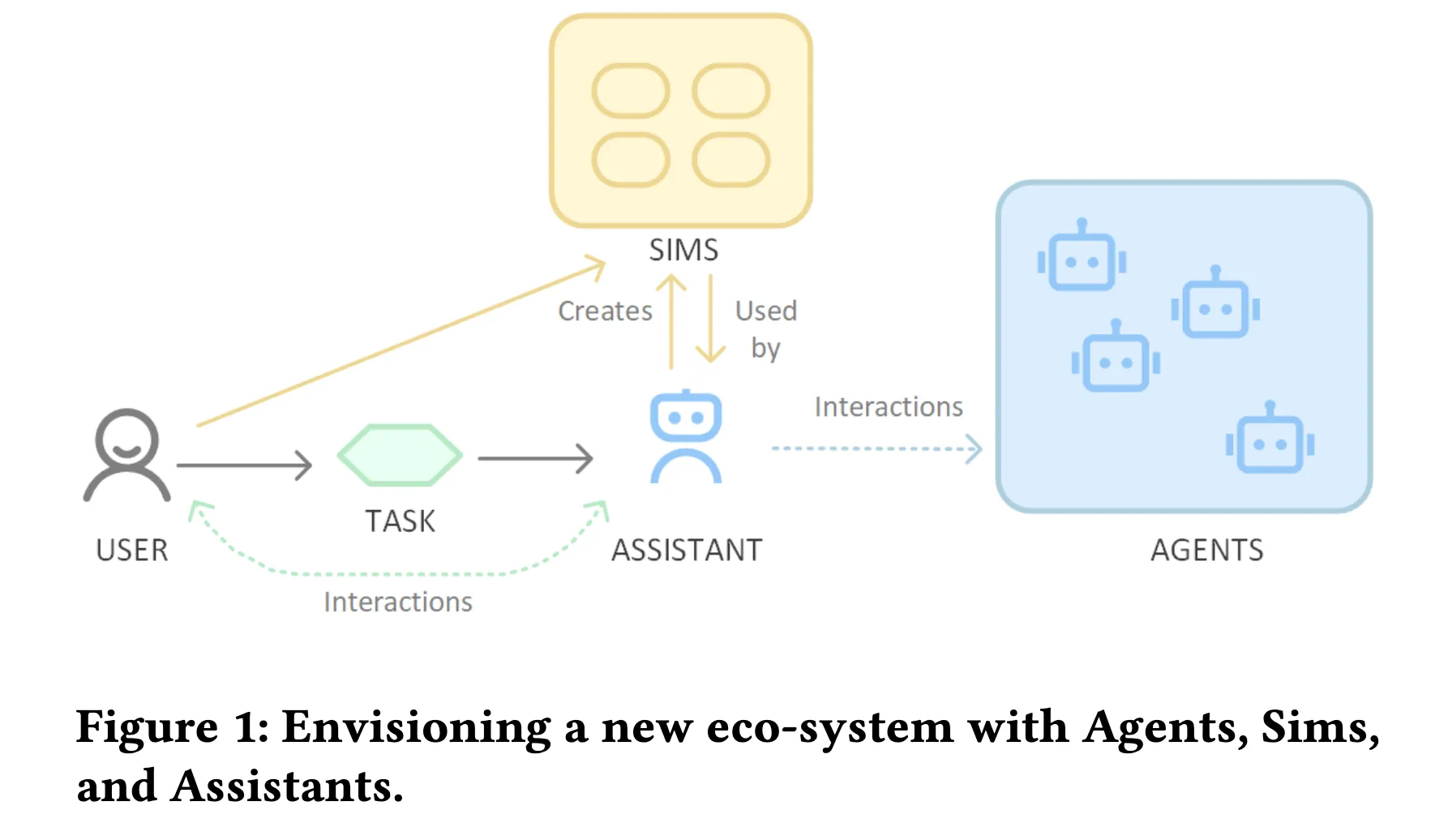
This is a systems proposal rather than a guarantee that the ecosystem will provide precise or personalised results. Its central point is that privacy, representation, and communication are part of the deployment problem alongside the capabilities of an individual agent.
Work with Nazmi
Build your AI system with Nazmi.
Tell us what you are building, what exists today, and where your team needs help.
Start a conversation or book a 20-minute call →