
Reinforcement Learning Fine-Tuning by OpenAI
OpenAI just announced Reinforcement Fine-Tuning. Here is the demo:
Reinforcement Fine-Tuning — 12 Days of OpenAI: Day 2
But what is Reinforcement Fine-Tuning (RFT)?
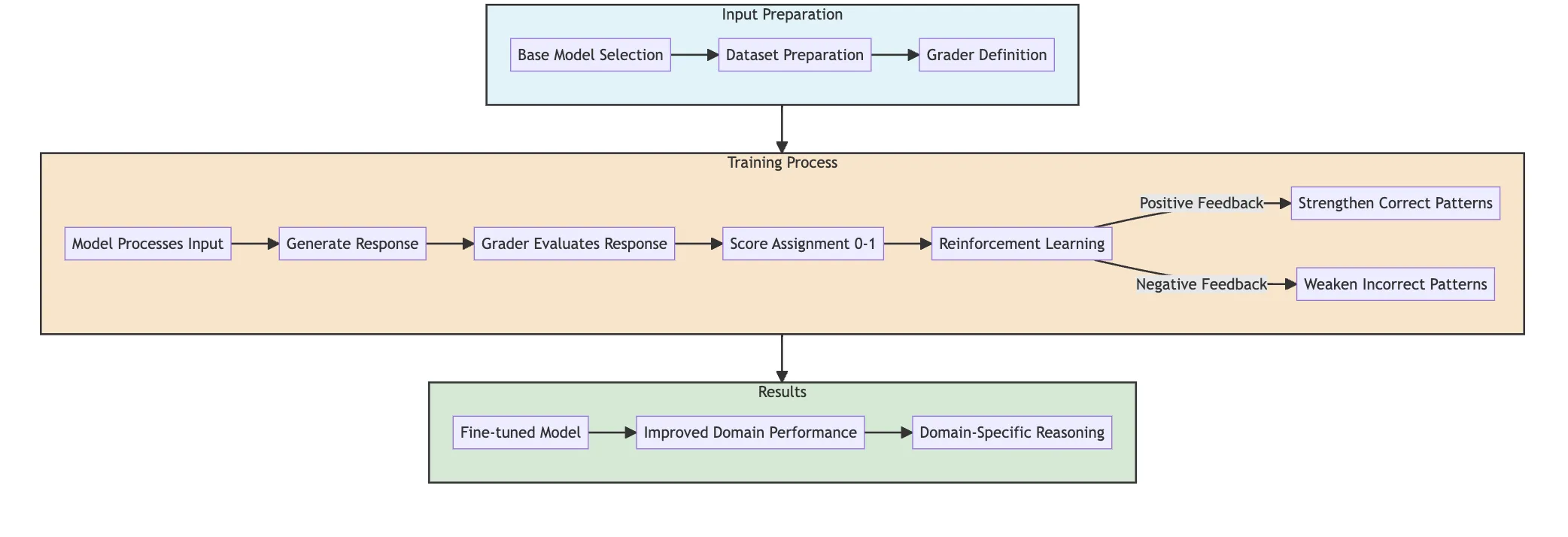
RFT is a new model customization technique that allows users to fine-tune OpenAI’s models (specifically the O1 series) using reinforcement learning rather than traditional supervised fine-tuning. The key difference is that while supervised fine-tuning teaches models to mimic inputs, RFT teaches models to develop new reasoning capabilities over custom domains.
How it works:
1. Data Preparation
- Users provide a dataset in JSONL format
- Each entry contains:
- Input data (e.g., a problem or case)
- Instructions for the model
- The correct answer (used for grading, not shown to model during training)
2. Grading System
- Users define or use pre-built “graders”
- Graders score model outputs from 0 to 1
- Scores can be binary or partial credit
- The grading helps reinforce correct reasoning patterns
3. Training Process
- When the model sees a problem, it’s given space to think
- The model’s answer is graded
- Reinforcement learning algorithms:
- Reinforce thinking patterns that led to correct answers
- Disincentivize patterns that led to incorrect answers
Key Benefits
- Can achieve results with very small datasets (as few as dozens of examples)
- Allows models to learn new reasoning capabilities, not just mimicry
- Can make smaller models perform better than larger base models
- Works especially well for tasks requiring deep expertise
Example: Genetic Disease Diagnosis
The example in the demo is genetic disease diagnosis:
Input:
- Patient case reports containing:
- Symptoms present
- Symptoms absent
- Patient history
Task:
- Identify genes potentially responsible for genetic diseases
- Rank genes by likelihood
- Provide reasoning for selections
Results shown in the demo:
- Base O1-mini: 17.7% accuracy
- Base O1: 25% accuracy
- RFT-trained O1-mini: 31% accuracy
The impressive part was that the fine-tuned smaller model (O1-mini) outperformed the larger base model (O1) after reinforcement fine-tuning.
Conclusion
This technique represents a significant advancement in model customization, allowing organizations to create highly specialized AI models for complex domain-specific tasks while requiring relatively small amounts of training data.
Work with Nazmi
Have a problem like this to ship?
The two-week AI Opportunity Audit turns it into a prioritized map, a 90-day roadmap, and one build-ready spec — a fixed-fee first step.
See the AI Opportunity Audit or book a 20-minute call →