
The AI Scientist: Towards Fully Automated Open-Ended Scientific Discovery
Introduction
One of the significant challenges in artificial general intelligence is developing agents capable of conducting scientific research and discovering new knowledge independently. While frontier models assist human scientists in brainstorming ideas, coding, or predictions, they still handle only a small portion of the scientific process. This paper introduces “The AI Scientist,” a comprehensive framework for fully autonomous scientific discovery. The AI Scientist can generate research ideas, write code, execute experiments, visualize results, draft complete scientific papers, and simulate peer reviews for evaluation. By iterating this process, it mimics the scientific community’s operation, creating a growing archive of knowledge. Demonstrated across three machine learning subfields — diffusion modeling, transformer-based language modeling, and learning dynamics — the framework can generate publishable-quality research papers for under $15 each. An automated reviewer, validated to achieve near-human evaluation performance, ensures the generated papers meet the acceptance thresholds of top-tier machine learning conferences. This marks a transformative era in leveraging AI for end-to-end research, enabling affordable and scalable creativity and innovation to tackle global challenges.
AI Scientist Main Phases
Overview
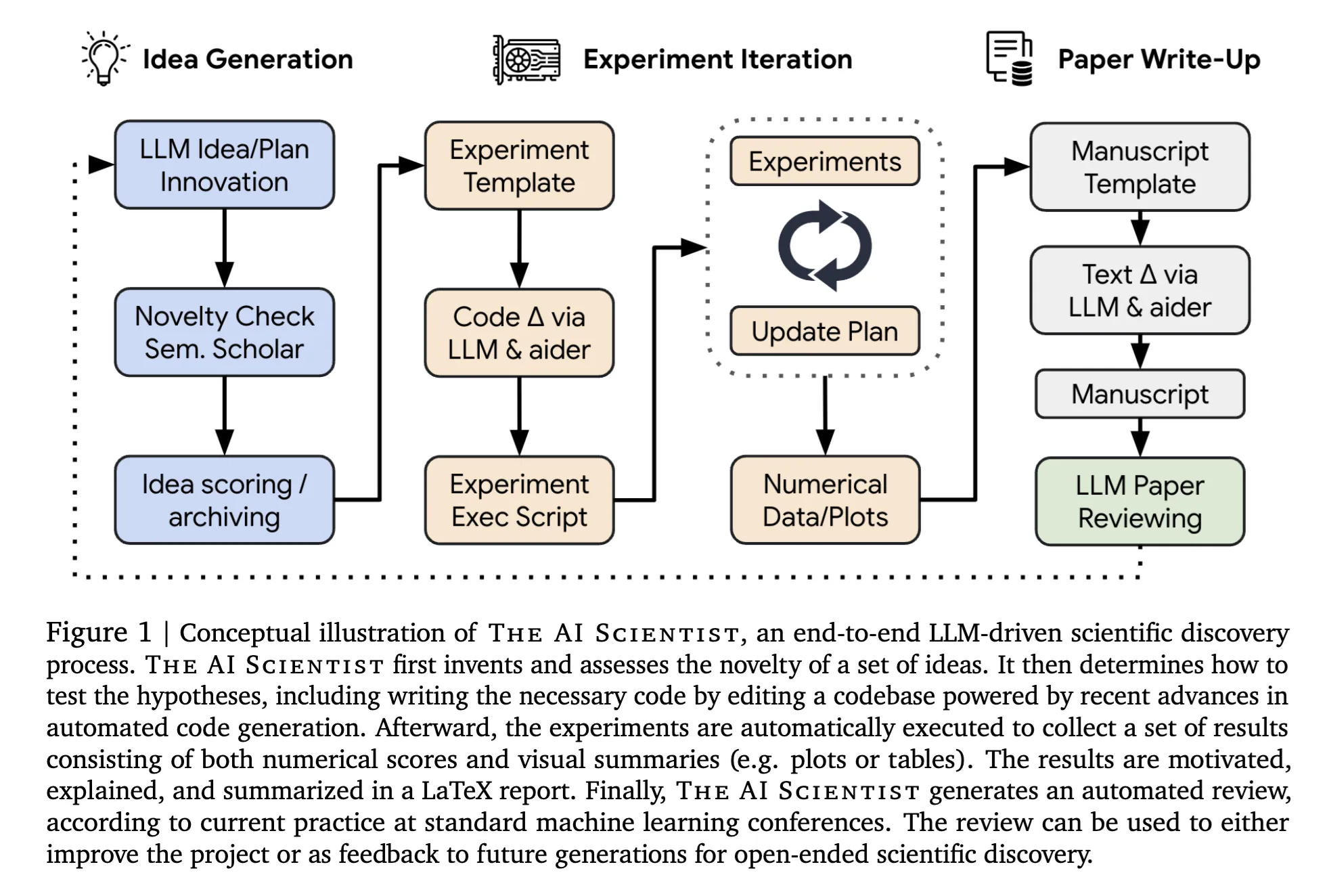
The AI Scientist framework operates in three main phases: (1) Idea Generation, (2) Experiment Iteration, and (3) Paper Write-up. A simulated review process assesses the generated papers’ quality. Each run begins with a baseline code template for lightweight experiments, ensuring computational efficiency. The process employs small-scale experiments as a starting point, allowing the framework to explore diverse research directions.
1. Idea Generation
Using a starting template, The AI Scientist brainstorms novel research directions, leveraging principles from evolutionary computation and open-endedness research. Each idea includes a description, an experiment plan, and self-assessed scores for interestingness, novelty, and feasibility. The framework employs multiple rounds of chain-of-thought reasoning and self-reflection to refine ideas. To avoid redundancy, it connects to the Semantic Scholar API and web tools to filter out ideas similar to existing literature.
2. Experiment Iteration
In this phase, The AI Scientist executes proposed experiments and visualizes results. It uses a system called Aider to plan, execute, and log experiments. Errors encountered during execution are iteratively resolved by Aider, ensuring robustness. After completing experiments, Aider creates figures and notes detailing the results. The framework can also design new plots and metrics beyond the provided templates, ensuring flexibility in capturing experimental outcomes.
3. Paper Write-up
The final phase involves drafting a complete scientific paper in LaTeX. Key steps include:
- Per-Section Text Generation: Aider compiles recorded notes and plots into sections like introduction, methods, and results, adhering to established guidelines for machine learning papers.
- Web Search for References: The AI Scientist polls the Semantic Scholar API to populate the related work section and ensure proper citations.
- Refinement: A final round of self-reflection reduces verbosity and enhances clarity.
- Compilation: The draft is compiled into a final LaTeX document, with errors resolved automatically by Aider.
Reviewer Agent
A critical aspect of scientific research is peer review. To replicate this process, the framework employs a GPT-4-based reviewer agent. Following NeurIPS guidelines, the agent evaluates papers using numerical scores (e.g., soundness, contribution, presentation) and generates lists of strengths, weaknesses, and a binary decision (accept/reject). Threshold-based post-calibration ensures robust decisions. This automated reviewer demonstrates near-human performance in evaluating the quality of papers generated by The AI Scientist, validating their readiness for publication in top-tier conferences.
Resources
Work with Nazmi
Have a problem like this to ship?
The two-week AI Opportunity Audit turns it into a prioritized map, a 90-day roadmap, and one build-ready spec — a fixed-fee first step.
See the AI Opportunity Audit or book a 20-minute call →